
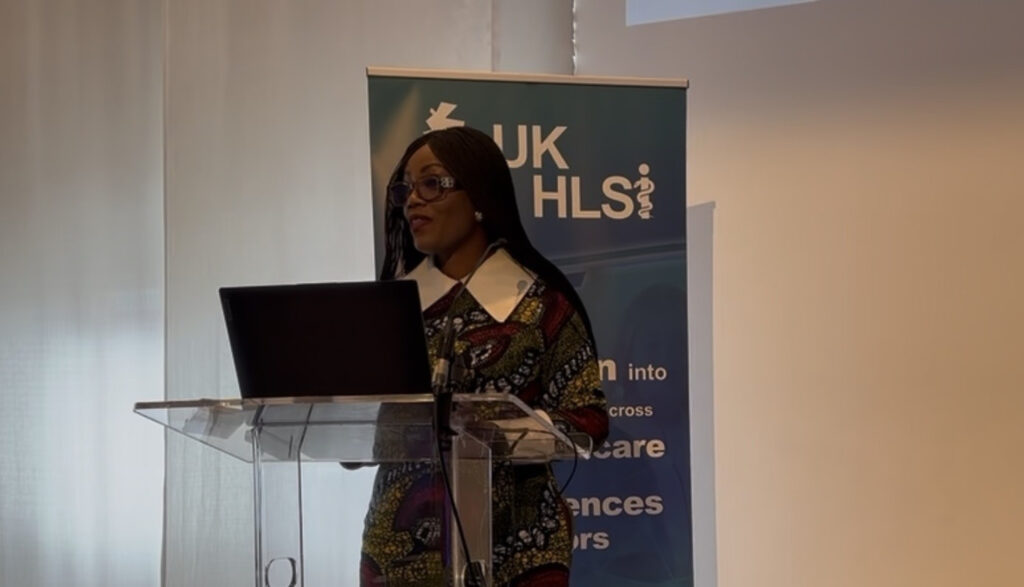

Wendy Olayiwola
National Maternity Lead for Equality, NHS EnglandSpeaking at the Women’s Healthcare and FemTech Summit in Manchester organised by UK Healthcare and Life Sciences Innovation (UKHLSI), NHS England’s National Maternity Lead for Equality set out how inequalities in health, access and experience shape maternity care. She called for services to respond to women’s needs across their lives, listen to their concerns and support a workforce able to deliver safe, inclusive care.
Maternity services only work well when every woman can understand and reach the care available to her and feels safe using it. That was the message from Wendy Olayiwola, National Maternity Lead for Equality at NHS England, at the Women’s Healthcare and FemTech Summit in Manchester.
Olayiwola’s contribution formed part of the summit’s morning programme, which followed the health journey women experience – from menstrual and reproductive health to pregnancy and maternity care. The wider event brought together healthcare leaders, policymakers, researchers, investors, employers, and innovators to discuss how to improve outcomes, reduce inequalities, and turn policy ambition into action.
“Maternity services only become meaningful when every woman – and I mean every woman – regardless of her background, ethnicity, where she was born or the postcode where she lives, understands the services available, can reach those services and feels safe within them,” she said.
Inequalities remain stark
Olayiwola said evidence continued to show unequal outcomes in maternity care, particularly for Black and Asian women and women living in deprived areas. She cited the latest MBRRACE-UK report, which recorded 257 maternal deaths during pregnancy or within six weeks of the end of pregnancy between 2021 and 2023.
The report put the maternal mortality rate at 12.44 per 100,000 maternities for white women, 16.74 for Asian women, and 28.21 for Black women. Black women remained 2.3 times more likely to die than white women, while women in the most deprived areas were 1.9 times more likely to experience maternal mortality.
Olayiwola said the figures sat within wider inequalities across women’s health. Women in the wealthiest areas live almost ten years longer than women in the poorest, she noted, and can expect around 20 more years in good health.
She stressed that these differences were not inevitable. They were shaped by systemic, structural and cultural factors – and could be prevented.
“These inequalities are absolutely not inevitable. They are preventable.”
She also highlighted the importance of listening to women’s experiences alongside mortality figures and formal reviews. Around one in ten women reported that concerns raised during labour and birth were not taken seriously in the 2025 survey, she said.
Care must follow the whole life course
One of the main themes of Olayiwola’s speech was that women’s health should not be treated as a set of separate services. Menstrual health, fertility, pregnancy, postnatal recovery, and later life are connected parts of a woman’s health journey, she argued.
Social conditions also shape health before a woman reaches maternity services. Food insecurity, unsafe housing and inflexible work can affect women’s health and access to care. Preconception support can help manage existing conditions, including diabetes, epilepsy and cardiovascular disease, before pregnancy begins.
The summit agenda was designed around a similar life-course approach, connecting lived experience and inequalities with discussions about research, innovation, funding, and delivery. Its afternoon programme shifted the focus to what government, health systems, investors, employers, and innovators could do to improve outcomes.
Respectful care and a supported workforce
Olayiwola described respectful care as part of clinical quality, not an optional addition. It means giving women clear information, gaining their consent and making sure they feel able to return when their symptoms change. It also means listening to women, believing them and providing professional interpretation when needed.
She called for women’s reported experiences to be measured and considered alongside clinical outcomes, with data reviewed across different communities.
The workforce, she added, is central to whether policy becomes good care. Discrimination and fear of speaking up can affect communication, decision-making, and escalation. She also highlighted the importance of representation and career progression for Black and brown staff.
“The workforce is the medium through which policy becomes care.”
Olayiwola said responsibility for tackling maternity inequalities extended beyond the NHS. NHS and integrated care board leaders, policymakers, commissioners, investors, and innovators all had a role to play.
She concluded by returning to the importance of acting before women enter maternity services. By the time someone reaches fertility or maternity care, opportunities to address some risks may already have been missed. Improving outcomes therefore requires action on wider population health as well as women’s health.

The summit’s wider aim was to turn those discussions into practical recommendations, partnerships and continued work through a Women’s Healthcare Working Group.
Olayiwola’s key message was that lasting progress depends on connecting those commitments with the experiences women have throughout their lives.
Get involved – Women’s Health Working Group
To find out more about getting involved with UKHLSI’s Women’s Health Working Group chaired by former Shadow Minister for Women and Equalities, and Mental Health and Social Care, Paula Sherriff, please contact enquiries@ukhlsi.co.uk